How to Teach Your Children About Money and Finance
Money habits often form long before adulthood. Children observe how spending, saving, and decision-making happen at home. Those early observations shape how they approach finances later in life. Schools introduced financial education to the national curriculum more than a decade ago, yet research suggests the impact has been limited.
A survey published by Santander found that three out of four school leavers reported never receiving financial education during their schooling. Many young adults also expressed confidence in their financial knowledge, yet the numbers told a different story. Seventy-nine percent had never created a budget, while 76% had never paid a bill.
These figures raise a pressing question: where should financial education actually begin? For many experts and families, the answer is simple—at home. Everyday interactions with money can offer lessons that classrooms often struggle to deliver.
The Gap in Financial Education

Freepik | Parents play a key role in guiding children toward confident and responsible money decisions.
Policy efforts aimed to strengthen financial literacy in schools, yet many young adults continue to leave education with limited experience managing money.
Financial adviser firm Boon Brokers conducted its own study following Santander’s findings. Managing director Gerard Boon explained the results clearly:
“We found 83% of young adults did not list school as their main source of education around finance. The majority of young adults are leaving school with a worrying lack of financial education.”
The consequences appear later in adulthood. Research by financial education charity Money Ready found that the average adult in the UK lost around £640 in one year simply by delaying major financial decisions they found confusing.
Many people avoid important choices because they feel uncertain about managing their money. According to the same research:
– More than four in ten Britons believe stronger budgeting skills could have helped them save more.
– Around one-third admit they avoid financial decisions because they do not know where to begin.
School leaders often point out that the curriculum already includes academic subjects alongside personal, social, health, and economic education. Time inside the school day remains limited. As a result, families often play the largest role in teaching practical financial habits.
A survey by charity Young Enterprise highlights this shift. Sixty-one percent of Generation Z turn to family members for financial advice, while only 13% consider school or college among their top sources.
Financial Lessons Begin with Simple Habits
Financial education does not require formal lessons or complicated explanations. Many children understand money best through daily experiences.
Former primary school teacher Becky Harris, now working at Realise Wealth Management, emphasizes this point:
“It’s great for children to be exposed to money little and often. Popping to the shops? Involve them in the process. Ordering a takeaway? Let them help you budget.”
Small moments during routine activities help children connect money with real-world choices. Grocery shopping, planning meals, or comparing prices can introduce concepts such as cost, value, and trade-offs.
Harris also notes that modern payment methods can make money feel abstract to children.
“In a society where physical money is used less and less, allowing them to engage with coins and notes is not only fun, but also helps link their understanding to the real cost of things—even when tapping a contactless card.”
Handling cash can help younger children visualize the idea of spending and saving.
Why the Piggy Bank Still Works
Despite the rise of digital payments, traditional methods remain effective learning tools.
A piggy bank offers a clear, visible way for children to see their money grow—or shrink. When pocket money is added to the jar, children notice progress. When spending happens, the decrease becomes equally obvious.
This simple method builds an early understanding of:
– Saving toward a goal
– The consequences of spending quickly
– Tracking money over time
Physical interaction with money often creates stronger awareness than purely digital transactions.
Still, modern banking tools have introduced new options that can also teach useful skills.
Digital Banking Tools for Children

Freepik | Companies are increasingly launching digital banking and prepaid cards for children.
Financial services aimed at younger users have expanded rapidly in recent years. Several companies now offer prepaid debit cards and apps designed for children.
These accounts often allow children as young as six to receive a prepaid card. Parents can load money onto the card, and children can use it to make purchases online or in stores. Cash withdrawals are also possible in many cases.
These systems generally include built-in safeguards. Children cannot spend beyond their available balance, so there is no overdraft risk. Most services also offer a mobile app that lets you monitor spending.
The apps often include extra features such as:
– Splitting money into spending and saving categories
– Setting aside small amounts for charity
– Allowing parents to set spending limits or block certain purchases
Tim Bennett, head of education at wealth-management firm Killik & Co and former deputy editor of MoneyWeek, believes these tools can introduce realistic money management.
“A prepaid debit card provides a means to pay rewards for helping around the home and gives children a way to build realistic budgets and think about financial goals, such as funding a trip or even part of university costs.”
Bennett also stresses the importance of regular conversations about money.
“Parents should make time to talk about budgeting and help children begin thinking about how their savings might grow.”
While these products provide useful practice, they often include monthly fees or transaction charges.
Traditional Bank Accounts for Older Children
For children aged 11 and above, many banks offer standard youth bank accounts. These accounts typically operate much like adult accounts, though overdrafts remain unavailable.
Children receive a debit card and access to mobile banking. They can also set up regular payments such as standing orders.
Unlike prepaid cards, these accounts require children to open them personally, though parents may assist with the process. Once opened, parents generally cannot control how the money is spent.
Several financial institutions offer youth accounts with competitive interest rates. Interest on balances encourages saving while introducing the concept of earning money through deposits.
Learning Through Educational Resources
Practical experience helps, yet educational materials can strengthen understanding. Many major banks now produce resources designed for young learners. These materials often include podcasts, videos, online games, and interactive lessons.
Families who prefer non-corporate options can explore programs from Young Enterprise, which operates the Money Heroes initiative. The program provides guides and learning tools aimed primarily at children aged three to eleven.
Another well-known resource comes from Money Saving Expert, the consumer website founded by Martin Lewis. Lewis has produced educational videos explaining core personal finance topics in simple language suitable for younger audiences.
Youth organizations also support financial learning. Within scouting programs, Beavers and Cubs can work toward the Money Skills Activity Badge, while the Guides Association offers Live Smart badges that cover similar financial concepts.
The Influence of Parental Behavior
Educational resources and banking tools support children, but observation often provides the most powerful lessons.
Liz Hunter from MoneyExpert emphasizes:
“It’s vital to talk about money early. Experiences at home shape financial behavior more than anything else. Studies indicate adult money habits often form in childhood through parents, friends, and media.”
Children watch how adults budget, spend, and save, which often becomes a model for their own financial decisions.
Pocket money also influences habits. Hunter explains:
“Giving too much pocket money can affect future behavior. Children may become reliant on parents and less motivated to earn independently.”
Moderate allowances encourage saving for larger purchases rather than immediate spending.
Typical Pocket Money Levels
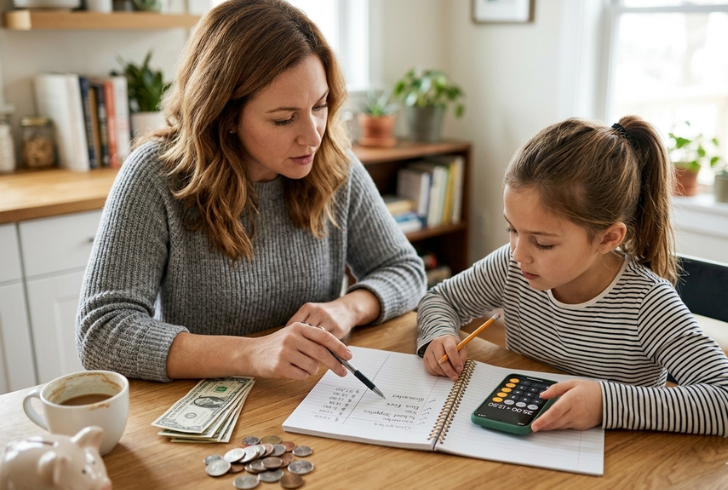
Gemini AI | Hands-on lessons like allowances and trip budgets help children learn smart money habits early.
Allowances vary, but surveys offer guidance. NatWest Bank found that UK seven-year-olds receive £2.85 weekly, rising to £3.67 at eleven and £6.59 at sixteen.
Large allowances without responsibility can weaken financial discipline and planning.
Practical Ways Families Teach Money Skills
Parents often use real-life situations as teaching tools. Sam Morris, a business owner with children aged twelve and sixteen, explains:
“During trips, the children were given a weekly budget for food and activities. They decided how to allocate it. Choosing an expensive restaurant one day required adjusting spending for the following days.”
This type of decision-making helps children recognize trade-offs and long-term thinking.
Personal finance expert Kate Steere from comparison site Finder focuses on giving children ownership of money decisions.
“A weekly allowance allows children to make real choices and develop healthy habits. They were also given control of a family day-out budget of £100 and asked to manage the spending for the day.”
Similarly, chartered accountant Emma Ball, who has two sons aged ten and seven, integrates financial lessons into daily life.
“The children are involved in practical decisions such as saving for larger purchases or planning treats. Their pocket money is divided into spending, saving, and giving.”
Ball also points out a modern challenge. Digital payments often hide the tangible value of money.
“Instant payments, apps, and online shopping make it harder for children to see what money actually represents. A culture focused on immediate rewards makes good financial habits harder to teach.”
Financial education rarely develops from classroom lessons alone. Real understanding grows through everyday practice, honest conversations, and thoughtful guidance at home. Schools, banks, and organizations provide helpful resources, yet family influence remains the strongest factor in shaping financial habits.
Children who learn to budget, save, and think carefully about spending gain confidence that continues into adulthood. Small lessons today often lead to stronger financial choices for years to come.